
Explore our training programme
Our helicopter flight school offers personal, hands-on training from your first flight to your licence. With experienced instructors and clearly structured programmes we teach the foundations of safe, responsible and professional helicopter flying.
Interested in a trial flight?
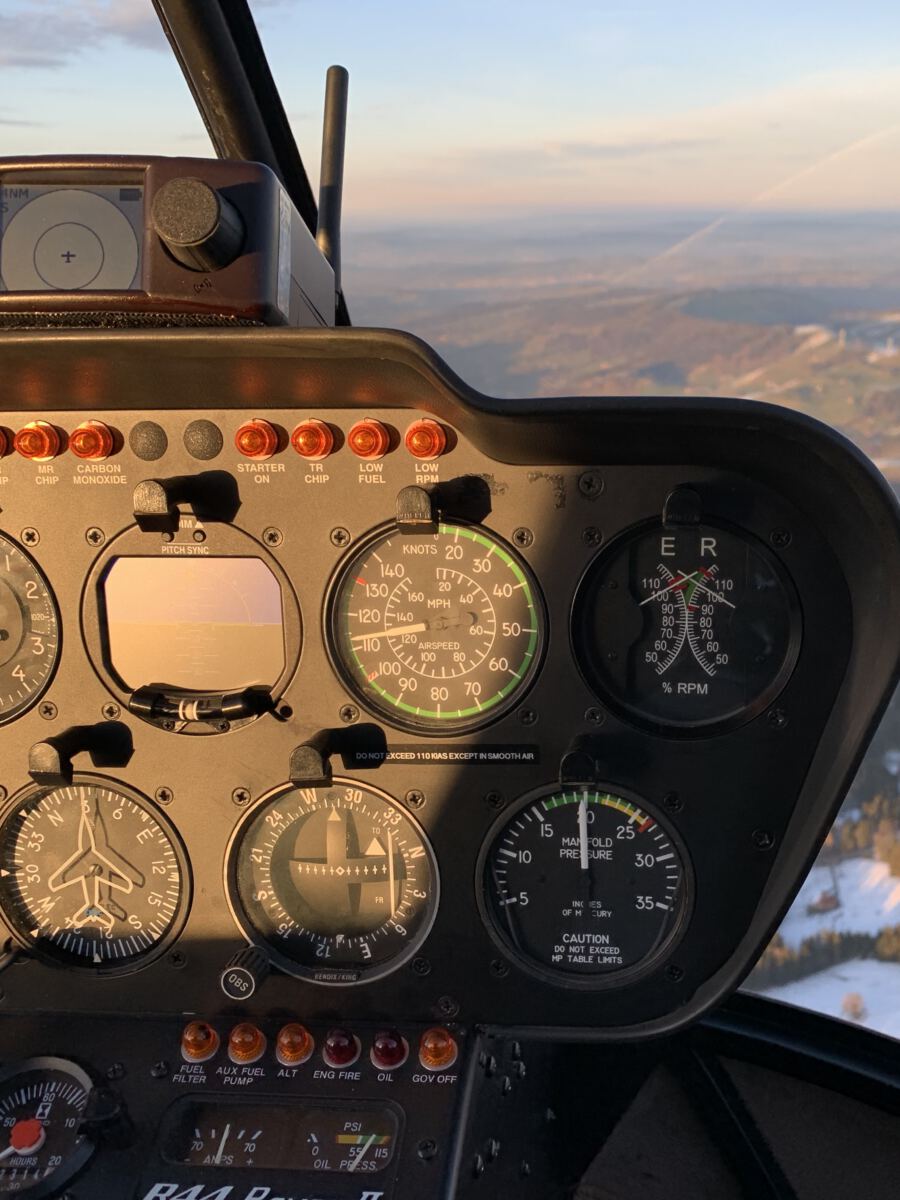
A trial flight is the ideal way to experience helicopter flying first-hand. No previous knowledge is required. After a short briefing, one of our instructors will gently introduce you to flying on dual controls. You get an insight into the basic control movements, how the helicopter behaves and how things work in the cockpit.
- Briefing with a flight instructor
- A realistic flying experience
- An insight into the training programme
Training at Airport Helicopter
From the private pilot licence to the flight instructor rating – choose a course to see all the details on prerequisites, theory and practical training.
The private pilot licence for helicopters, PPL(H), is the first step towards flying a helicopter on your own. It entitles you to act as pilot in command on private, non-commercial flights. The course combines theory and practice and teaches the flying, technical and navigational foundations for handling a helicopter safely. The PPL(H) is also the basis for further ratings and for later commercial pilot training.
Prerequisites
- Minimum age 17 at the time of the test
- Class 2 medical certificate, examination by an FOCA-approved aeromedical examiner
Theoretical training
The theoretical training covers nine main subjects, divided into general and helicopter-specific topics. You study on your own; before registering for the examinations, a mandatory classroom seminar must be attended for each subject, in which the material is revised with an instructor and any questions are cleared up. Each subject is then completed with a written examination held on site by the Federal Office of Civil Aviation (FOCA). All theoretical examinations must be passed within 18 months, counted from the end of the calendar month in which the first examination was taken. After the last examination is passed, the skill test must be completed within 24 months.
General subjects
- 010 Air law
- 040 Human performance
- 050 Meteorology
- 060 Navigation
- 090 Communications
Helicopter-specific subjects
- 020 Aircraft general knowledge
- 030 Flight performance and planning
- 070 Operational procedures
- 080 Principles of flight
Practical training
The practical training comprises a minimum of 45 flight hours, of which 10 hours are flown solo under the supervision of an instructor. Alongside the flying, radiotelephony training and an English language test are part of the practical training.
VFR communication
This is practical training in communicating correctly with air traffic control and other airspace users. It builds on the theory of subject 090 Communications. In the practical voice training, various simulated flights are played through and the corresponding radio procedures practised. This part concludes with a practical radiotelephony examination in the classroom, in which the candidate takes the role of the pilot and the examiner the role of the air traffic services.
English language
Beyond the standard phraseology learned during VFR communication training, it is important to be able to make yourself understood in situations the standard phrases do not cover. A minimum level 4 is required. The corresponding language proficiency test can be taken comfortably from home via one of the usual video conferencing providers.
Skill test
Once you are ready, a skill test is flown with an examiner from FOCA. This flight concludes the private pilot training.
The commercial pilot licence for helicopters, CPL(H), is the next step after the private pilot licence and the basis for working professionally as a helicopter pilot. It entitles you to conduct helicopter flights commercially and to act as pilot in command in commercial operations.
Prerequisites
- Minimum age 18 at the skill test
- Class 1 medical certificate
- Valid PPL(H) licence
- 155 hours of flight experience, including 50 hours PIC and 10 hours cross-country
Theoretical training
The theoretical training deepens the subjects already known from private pilot training. We recommend taking the subjects in English. There are three levels of theory: CPL(H) Commercial Pilot Licence, ATPL(H)/VFR and ATPL(H)/IR. In general it is worth taking the ATPL(H) theory, as many companies like to see it today, and the additional effort compared with the CPL(H) is relatively small. For theoretical instruction we work with external providers who deliver the training professionally.
Subjects
- 010 Air Law
- 021 Aircraft General Knowledge
- 022 Instrumentation
- 031 Mass and Balance
- 033 Flight Planning and Flight Monitoring
- 034 Performance (Helicopter)
- 040 Human Performance and Limitation
- 050 Meteorology
- 061 General Navigation
- 062 Radio Navigation
- 070 Operational Procedures
- 082 Principles of Flight (Helicopter)
- 090 Communications
Practical training
The practical training comprises a minimum of 30 hours of dual instruction and can be flown with us on a piston-engine or a turbine helicopter. Of these, 20 hours are visual flight instruction and 10 hours instrument flight instruction. If not already completed, an additional 5 hours of night flying are flown, which take place exclusively during the winter months.
To sit the skill test, a total of at least 185 flight hours must be shown, including 50 hours as pilot in command with 10 hours of cross-country flying. These must include a cross-country flight of at least 185 kilometres with a landing at two aerodromes other than the aerodrome of departure.
Skill test
Once you are ready, a skill test is flown with an examiner from FOCA. This flight concludes the commercial pilot training.
The night rating for helicopters, NIT(H), allows pilots to fly a helicopter under visual flight rules at night as well. Flying in darkness places particular demands on perception, orientation and flight planning. Missing visual references, reduced visibility and optical illusions call for precise flying technique and confident use of the instruments.
The course teaches the theoretical and practical foundations for conducting night flights safely and is at the same time an important building block on the way to the commercial pilot licence CPL(H).
Prerequisites
- Valid PPL(H) licence
- For entry in a PPL(H): at least 100 hours of flight experience after licence issue
- Of which at least 60 hours as pilot in command (PIC)
- Of which at least 20 hours cross-country as PIC
- These minimum hours do not apply when the course is taken as part of CPL(H) training
The entire NIT(H) course must be completed within six months.
Theoretical training
The theoretical training comprises at least 5 hours and covers the particularities of flight operations at night.
Instrument flight training
Before or during the night flying training, at least 10 hours of instrument flight instruction are flown on the helicopter.
Here you train flying without adequate outside visual references. The pilot learns to control attitude, altitude, speed and heading consistently by reference to the instruments and to react early to possible spatial disorientation.
Depending on the ratings held and the experience that can be credited, parts of this training may be credited.
Practical training
The practical training comprises at least 5 flight hours at night. Of these, at least:
- 3 hours must be flown with an instructor
- 1 hour of cross-country navigation must be included
- 5 solo circuits at night must be flown, each with one take-off and one landing
Night flying as part of the CPL(H)
For prospective commercial pilots the night rating course is mandatory. When it is flown as part of CPL(H) training, the minimum hours listed above – 100 hours after the PPL(H), of which 60 hours as PIC – do not apply. The five required night hours are not part of the 30-hour CPL(H) module but are flown separately.
Completing the course
No separate check flight is required for the NIT(H) rating. Once all prescribed theoretical and practical elements are completed, the flight school confirms completion of the course. The night rating can then be entered in the pilot licence.
The mountain flying rating for helicopters, MOU(H), is a Swiss national rating. It permits mountain landings above 1,100 metres above sea level. Changing wind and weather, high altitudes, demanding landing sites and the reduced performance of the helicopter call for forward-looking flight planning and precise flying technique.
During the course you acquire the knowledge and skills to approach mountain landing sites safely and to judge the particular conditions of alpine helicopter flying correctly. Besides the correct approach and landing technique, the focus is on assessing wind, terrain, obstacles, performance reserves and possible escape routes.
Prerequisites
- Valid PPL(H) or CPL(H) licence
- Valid medical certificate matching the licence held
- At least 100 hours of helicopter flight experience before the skill test
Theoretical training
The theoretical training consists of a block of classroom instruction held on site. A large part of the theory is linked directly to the flying training. There is no theoretical examination.
Practical training
The practical training starts at lower altitudes and works its way up step by step to the official mountain landing sites in the high Alps. Flying technique and decision-making are continuously adapted to more demanding conditions.
To obtain the MOU(H) rating, at least 200 approaches with landings must be completed. These comprise:
- at least 50 approaches and landings below 2,000 m AMSL
- at least 150 approaches with landings at official mountain landing sites
- at least 20 different mountain landing sites
- of which at least 10 different sites above 2,700 m AMSL
The number of flight hours required is not fixed and depends heavily on the pilot’s experience and individual progress. In practice, mountain flying training comprises several intensive blocks.
Completing the course
The course concludes with a check flight. Landings are flown at different altitudes – from lower ground up to a mountain landing site in the high Alps. Once passed, the MOU(H) entitles you to carry out landings in the mountains.
The flight instructor rating for helicopters, FI(H), allows experienced helicopter pilots to pass on their knowledge and flying experience to the next generation of pilots. Instructor training goes far beyond simply handling the helicopter: at its centre is the ability to convey flying and theoretical content clearly, in a structured and safe way, and to guide student pilots individually along their path.
Prerequisites
- Minimum age 18
- Valid CPL(H), or PPL(H) with the CPL(H) theoretical examination passed
- At least 250 hours total flight experience on helicopters
- With a CPL(H): at least 100 hours as PIC
- With a PPL(H): at least 200 hours as PIC
- At least 20 hours VFR cross-country as PIC
- At least 10 hours of instrument flight instruction, of which no more than 5 hours in a suitable simulator
- Pre-entry flight assessment passed
The pre-entry flight assessment must be flown within the six months before the FI(H) course starts, with a suitably qualified instructor. It establishes whether flying skills and theoretical knowledge meet the requirements for starting instructor training.
Theoretical training
Teaching and learning covers the pedagogical and didactic foundations of instructing. The future instructor learns to structure lessons sensibly, to define learning objectives and to allow for different rates of progress and needs among students. The teaching and learning element comprises at least 25 hours.
Alongside the pedagogical foundations, existing theoretical knowledge from pilot and commercial pilot training is deepened. The focus is no longer only on understanding the material yourself, but on passing it on in a structured and comprehensible way.
During the course you prepare and present your own teaching sequences. Both technical accuracy and method – how clearly the content is conveyed – are trained.
Practical training
The practical FI(H) training comprises at least 30 flight hours, of which at least 25 hours are flown as instruction with a qualified instructor.
Unlike ordinary pilot training, the emphasis is not on flying an exercise yourself, but on teaching it to a student correctly and comprehensibly. The trainee instructor increasingly takes the role of the instructor, while the supervising instructor plays the student.
Particular emphasis is placed on demonstrating each exercise precisely. An instructor must be able to fly an exercise correctly, observe the student at the same time and intervene safely and in good time when necessary.
Assessment of competence
Once all elements of the course are complete and you are ready, an assessment of competence is carried out with an authorised examiner.
Both the theoretical teaching skills and the practical instruction in the helicopter are assessed. During the assessment the candidate takes the role of the instructor and must show that a lesson can be planned, explained, demonstrated and safely conducted. Passing the assessment of competence grants the FI(H) rating.
FI(H) restricted
After the course, the FI(H) rating is initially exercised with restricted privileges. During this period, flight instruction takes place under the supervision of a suitably qualified instructor within a flight school.
In this phase the new instructor may not authorise a student’s first solo flights or first solo cross-country flights. The restriction can be lifted once at least:
- 100 hours of flight instruction on helicopters have been given, and
- 25 student solo flight exercises have been supervised.
Once this experience is reached, the restriction can be removed and the FI(H) rating exercised without that initial limitation. Instructor training is therefore not just an additional rating, but the start of a responsible role in which flying experience, teaching ability and a strong safety mindset come together.
A type rating entitles pilots to fly a particular helicopter type on their own. Every helicopter differs in its handling, systems, performance data and operating procedures. Type rating training therefore teaches precisely the theoretical and practical knowledge required to operate the type in question safely.
Prerequisites
- Valid PPL(H) or CPL(H) licence
- Valid medical certificate matching the licence held
- For a first turbine type, additionally the Turbine Engine Knowledge Course
Available types
We offer type rating training on the following helicopter types:
- Robinson R22 Beta
- Robinson R44 Raven II
- Bell 206 Jet Ranger III
- Airbus AS350 B2
The training can be taken both for a first type rating and by pilots who wish to extend their experience to another helicopter type.
Theoretical training
Before the practical conversion comes the technical ground course for the type in question. It is based on the manufacturer’s flight manual and covers the design and function of the systems, performance data, limitations, emergency procedures and the pre-flight inspection. Its length depends on the complexity of the type. The ground course concludes with a theoretical examination conducted by the flight school.
For helicopters with a two-blade rotor – in our fleet the Robinson R22, the Robinson R44 and the Bell 206 Jet Ranger – an introduction to the particularities of this rotor system is part of the training; for the Robinson types the awareness course to SFAR 73 is additionally required. It covers the particularities of this rotor system, among them mast bumping, low-G situations and rotor RPM decay. For R22 pilots it is mandatory and must be completed before the first solo flight.
Practical training
The extent of the flying training depends on the type and on previous experience and is usually between 2 and 10 flight hours. Pilots who already fly several helicopter types generally manage with the lower end of that range.
Completion and revalidation
The conversion concludes with a check flight, after which the type rating is entered in the licence. To keep it valid, at least 2 flight hours per type within the last 12 months and the recurrent proficiency check are required.
If you obtained your helicopter licence outside the EASA area, in the USA, Canada or New Zealand for example, it can be converted into a European licence. We guide you through that process, from the first assessment of where you stand to the skill test.
Converting a private pilot licence PPL(H) and converting a commercial pilot licence CPL(H) carry different requirements. How extensive the conversion turns out to be depends on your current licence and your flying experience. We review your documents beforehand and agree with you which theoretical examinations and which training flights are genuinely needed.
Converting a private pilot licence PPL(H)
Prerequisites
- Valid ICAO licence from a non-EASA state, PPL(H) or CPL(H)
- Proof of a radiotelephony privilege in the licence or an equivalent document
- Valid EASA class 2 medical certificate
- A complete logbook as evidence of your flying experience to date
- English language proficiency (minimum Language Proficiency Level 4)
- At least 100 hours of flight time as a pilot
Theoretical training
Two theoretical subjects must be completed for the conversion: air law and human performance. The written examinations are taken at the Federal Office of Civil Aviation (FOCA).
Practical training
Before the test you complete as many training flights as it takes to reach the required standard. The focus is on the procedures that differ from your previous training system: radio and approach procedures, the structure of Swiss airspace and the particularities of flying in the Alps.
The conversion ends with a skill test taken with a FOCA examiner. Your licence is then issued by the FOCA.
Converting a commercial pilot licence CPL(H)
Prerequisites
- Valid ICAO CPL(H) licence from a non-EASA state
- Proof of a radiotelephony privilege in the licence or an equivalent document
- Valid EASA class 1 medical certificate
- A complete logbook as evidence of your flying experience to date
- English language proficiency (minimum Language Proficiency Level 4)
Theoretical training
For this conversion all EASA CPL(H) or EASA ATPL(H) theoretical examinations must be passed. No previous theoretical knowledge is credited.
Practical training
Before the test you complete as many training flights as it takes to reach the required standard. The focus is on the procedures that differ from your previous training system: radio and approach procedures, the structure of Swiss airspace and the particularities of flying in the Alps.
The conversion ends with a skill test taken with a FOCA examiner. Your licence is then issued by the FOCA.
Questions about training?
We are happy to answer any questions about the various courses. We take time for that and prefer talking directly.